
In the AI Era, Winners Won't Have the Biggest Data — They'll Have the Best Organised Data
AI success depends on data before the model. Winners will not have the biggest data — but the most organised, reliable, and accessible.
AI has moved from tech companies' agendas to every sector's strategic priority. Manufacturers plan AI investments, logistics firms optimise operations, retail brands analyse customer behaviour, financial institutions build forecasting models.
Yet many organisations miss a critical truth: AI success depends on the data used — before the model used.
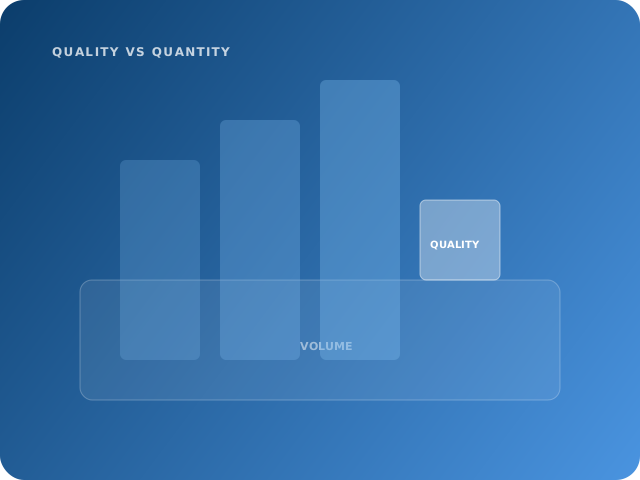
Many companies believe they have big data — millions of records, years of accumulated information, terabytes of data. But for AI, what matters is not data volume — it is data quality.
In the AI era, winners will not have the biggest data — but the most organised, most reliable, and most accessible data.
Big Data Does Not Always Mean Big Advantage
For years, companies were told: "Collect more data." That approach was partly right. But today, collecting data alone no longer creates competitive advantage — because almost everyone collects data.
The real question now: Is your collected data usable? In many organisations, sadly, no. When that happens, data volume grows but data value falls.
- The same customer may appear under different names in different systems.
- Information may be incomplete.
- Data may be outdated.
- Different departments may define the same concepts differently.
Why Does AI Depend on Data Quality?
AI models succeed only as well as the quality of what they learn. An AI model can predict churn, forecast sales, identify risks — but only with correct data.
AI on dirty data does not produce smarter decisions — it produces faster mistakes.
Data Architecture Is the Foundation of AI
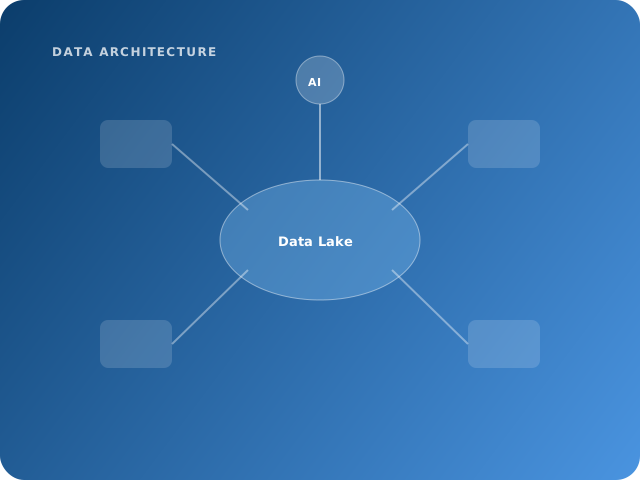
Data must not only be correct — it must also be accessible. When data in CRM, ERP, operations apps, mobile platforms, and finance systems does not unite under shared architecture, AI cannot see the full picture.
Successful organisations prepare a solid AI foundation with data warehouses, data lakes, and central data architectures.
System Integration Is AI's Ability to See
For AI to succeed, it must evaluate different data sources simultaneously: customer behaviour, operational performance, financial results, supply chain data.
When these sources are disconnected, AI must decide with incomplete information. API-based integration architectures are essential to AI transformation. AI's power comes not just from algorithms — but from the diversity of data it can access.
Garbage In, Garbage Out — feed faulty data into the system, and the results will be faulty too.
Corporate Checklist Before AI Investment
Clarify the answers to these questions before starting an AI project. If data quality answers are unclear, it may be too early for AI investment:
- Data Quality: Are our data current? What are duplicate rates, missing data ratios, and accuracy levels?
- Data Standardisation: Do all departments use the same data language?
- Data Architecture: Is data collected in a shared structure?
- Integration: Can AI automatically access the data it needs?
- Data Governance: Do we have rules to maintain data quality?
AI Cannot Succeed Without Data Governance
One of the most neglected areas in AI projects is data governance. Without defined rules, data degrades over time — clean data today may be unusable in months. AI is not just a technical project — it is an organisational discipline project.
- Who owns the data?
- Who can change the data?
- How is data validated?
- How is data quality maintained?
Conclusion
Success in the AI era will not come from building powerful models alone — data quality will make the difference. AI learns from data, decides with data, creates value with data.
Tomorrow's winners will not have the biggest data centres — but organisations that organise, manage, integrate, and make their data trustworthy.
When planning AI investments, ask not "How much data do we have?" but "Is our data organised enough for AI to trust?" Future competitive advantage will be determined by data quality — not data volume.
What do you think is the biggest gap in organisations' AI projects?
Not having enough data.
Existing data not being usable.
Let's build your data quality roadmap together
Share your data landscape — let us design your organised, reliable, AI-ready data infrastructure together.