
Why Do Boards Want Dashboards But Need Decision Support Systems?
Seeing a dashboard and deciding are not the same. Executives face data overload — what they need is the right recommendation at the right time.
Most digital transformation projects start with the same request: "Let's build an executive dashboard."
Show sales figures. Monitor operational performance. Consolidate financial indicators on one screen. Track KPIs in real time.
These requests are entirely natural — leaders want a quick, clear view of the organisation. Yet many organisations miss a critical truth:
Seeing a dashboard and being able to decide are not the same thing.
Today many executives access hundreds of data points. Yet they still ask: "Given this information, what should I do now?"
This is exactly where the difference between dashboards and Decision Support Systems emerges.
What Do Dashboards Solve?
Dashboard systems give executives visibility. They summarise the organisation's current state, bring performance indicators together, and make trends easier to see. They are indispensable for modern management.
Yet dashboards' core job is to display information — not to decide. An executive may see valuable data; but what they often really need is to understand why results occurred and what to do next.
- Sales dropped 12%.
- Operational costs rose.
- Customer satisfaction declined.
- Production efficiency fell.
Why Are Decision Support Systems Different?
Decision Support Systems (DSS) are not systems that merely present data — they interpret it. Their purpose is to accelerate the executive decision process.
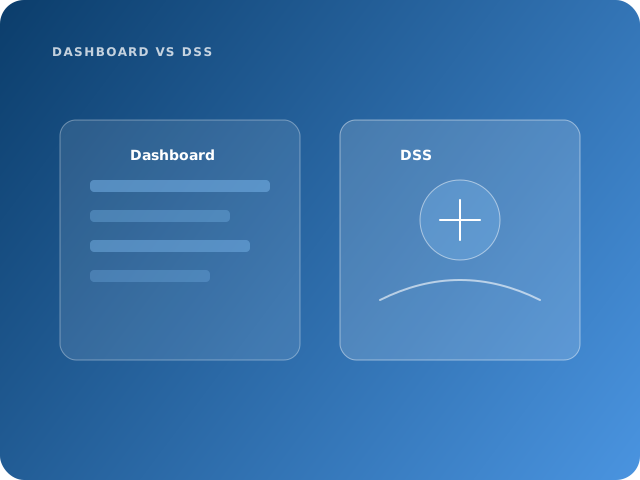
A dashboard says "Sales dropped 12%." A DSS presents the causes of the decline, ongoing risks, and actionable responses together. This is where data becomes information — and information becomes decision.
"Dashboard: "Sales dropped 12%.""
"DSS: The main cause is customer loss in a specific region. Competitor prices have changed. At the current trajectory, losses will continue. Price optimisation could reduce the loss by 40%."
In the Data Age, the Biggest Problem Is Not Lack of Information
Many organisations believe collecting more data is the solution. In reality, executives do not lack data — they suffer from data overload.
You can put hundreds of indicators in front of a CEO. But at the moment of decision, they do not need hundreds of charts — they need the right recommendation at the right time.
In modern management, the critical issue is not collecting data — it is making data meaningful.
What Boards Really Need: Scenario Generation
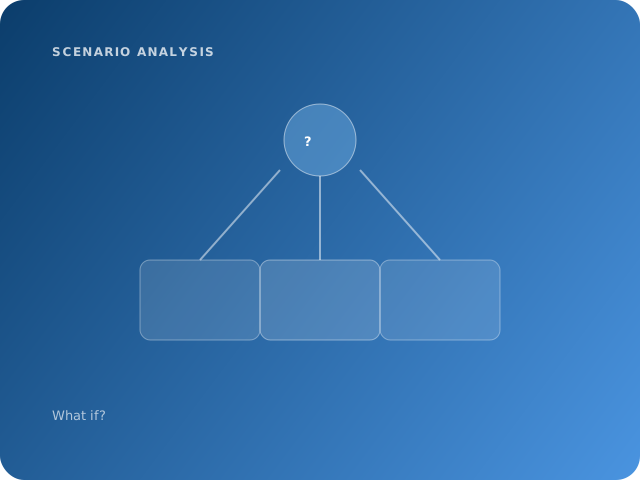
Boards do not meet to report the past — they meet to plan the future. One of the capabilities executives need most is scenario analysis.
The answers to these questions are not found in classic dashboards — they are generated by decision support systems.
- What happens if the exchange rate rises 10%?
- What is the impact if a new investment is delayed?
- Which regions are affected if operational costs rise?
- How does revenue projection change if a new product launches?
How AI Is Transforming Decision Support Systems
Traditional decision support systems analyse historical data. Next-generation systems are powered by AI — management screens shift from passive reporting tools to active advisors.
Tomorrow's management systems will not just display data — they will interpret it, offer recommendations, and support decision processes.
- Predicting risks
- Calculating probabilities
- Generating alternative scenarios
- Building recommendation engines
How Will Future Boards Work?
In the near future, successful leadership teams will not just read reports — they will work with decision support systems. They will use AI-powered analysis, foresee risks, evaluate alternative scenarios, and decide much faster.
Because competition is no longer won by having information — but by using it correctly and quickly.
How to Move from Dashboards to Decision Support Systems
This transformation requires three fundamental steps. When these three layers come together, organisations can truly adopt a data-driven management culture:
- Unify Data: Data from CRM, ERP, finance, operations, and other systems must meet in a shared data architecture.
- Define Business Rules: The system must know when to alert and what recommendations to generate.
- Add AI and Analytics Layer: Forecasting, risk analysis, and scenario generation must be built into the system.
Conclusion
Dashboard systems are indispensable for modern management — yet they are not enough alone. Executives need more than seeing what happened — they need to understand why, predict what will happen, and know what to do.
Decision Support Systems fill exactly this gap. Tomorrow's successful organisations will not be those with the most data — but those that make the best decisions fastest.
Behind them will be not just dashboards — but strong decision support mechanisms.
Do your organisation's dashboards truly make decision-making easier?
Yes — data accelerates our decision process.
No — they only work as digital scoreboards showing what happened.
Let's design your decision support infrastructure
Share your current dashboards and decision processes — let us build your roadmap from data to action together.