Integration Problems
Dozens of systems are deployed without planning how they work together. Employees carry data between systems, Excel files circulate, manual work increases — the opposite of digital transformation's purpose.

Wrong question: "Which software should we buy?" Right question: "What architecture should we build?" Software is temporary — architecture lasts.
Many organisations begin digital transformation by buying new software. New ERP systems are deployed, CRM projects launched, mobile apps developed, AI platforms activated, cloud migrations executed.
All are significant investments. Yet a striking truth remains: a large share of digital transformation projects fail to deliver expected business value.
Because organisations often focus on the wrong question: "Which software should we buy?" The real question is: "What architecture should we build?"
The essence of digital transformation is not buying technology — it is building enterprise architecture.
Software changes. Technologies change. Trends change. Today's systems may be replaced in a few years.
Yet enterprise architecture is long-lived. Architecture defines how data moves, how processes work, how systems communicate, and how the organisation scales.
Successful organisations design architecture before choosing technology.

In many organisations, every new problem is solved with new software. Sales issues? Buy a new CRM. Operations problems? Deploy a new tracking system. HR needs? New platform. Reporting? New tools.
This approach looks like a short-term fix. Long term, it creates a complex technology ecosystem — and the organisation becomes more sluggish while believing it has digitised.
Architectural thinking means thinking about the system before technology. Technology investments without answering these questions are often short-lived — because technology exists, but there is no architecture to guide it.
Many organisations can buy the same software, use the same AI tools, access the same cloud services. Technology is now accessible to everyone.
Competitive advantage lies not in technology itself — but in how technologies are assembled. Successful organisations do not buy software — they build systems, create ecosystems, design architecture — and easily add new technologies on top.
AI projects have made enterprise architecture's importance more visible. AI requires clean data, integrated systems, and standardised processes. Without these, AI cannot deliver expected value.
Successful AI projects of the future will be built on strong architectural foundations.
Companies that advance without enterprise architecture face serious structural problems long term.
Dozens of systems are deployed without planning how they work together. Employees carry data between systems, Excel files circulate, manual work increases — the opposite of digital transformation's purpose.
Customer data in one system, operations data elsewhere, financial data on another platform. Creating a shared reality becomes hard; management sees different reports on the same topic.
Organisations become dependent on their software. Changing a system becomes high risk, adopting new technology gets harder, flexibility is lost.
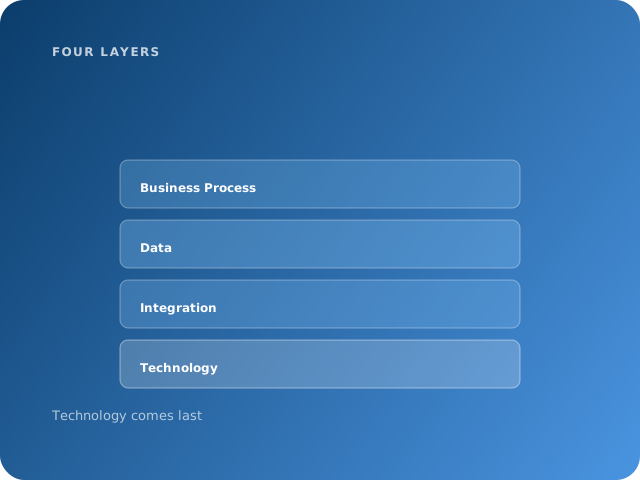
Successful organisations do not start digital transformation with software — they first define four core layers. This sequence is critical; technology is the last step, not the first:
Digital transformation is not a software purchase project — it is a process of building enterprise architecture. Software may change, technologies may change, platforms may change. But well-designed architecture continues to carry the organisation into the future.
The first question should not be "Which software should we buy?" The real question: "What architecture will support both our today and our tomorrow?"
Tomorrow's winners will not be those with the most software — but those that build the strongest, most flexible, and most sustainable architecture.
Software-focused — every problem is tackled with a new tool.
Architecture-focused — system and data structure are designed first.
Share your system landscape and transformation goals — let us build your architecture-first roadmap together.