Manufacturing
Thousands of data points are collected from hundreds of machines every second. OI analyses machine behaviour, compares with past failure records, and alerts maintenance teams before downtime — predictive maintenance.

Data-rich, insight-poor: Operational Intelligence converts live data into instant decisions. BI reports the past; OI manages today.
In recent years, organisations have invested heavily in data collection.
Production facilities were equipped with sensors. Fleet tracking was deployed. ERP and CRM projects went live. Customer behaviour began to be tracked on digital platforms.
Today many organisations have far more data than ever before. Yet a critical question remains unanswered:
Does this data truly enable better decisions?
In many organisations, as data volume grows, decision quality does not keep pace. Companies become data-rich — yet remain insight-poor.
This is where Operational Intelligence enters the picture.
Operational Intelligence is the approach of continuously analysing live data within an organisation to provide real-time decision support to leaders and operations teams.
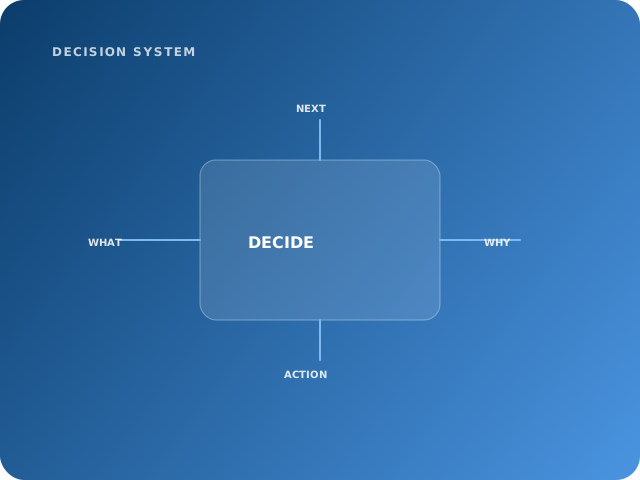
The goal is not just to see what happened. It is to understand what happened, why it happened, what will happen next, and what should be done.
Operational Intelligence is not just a reporting system — it is a decision-making system.
Many organisations have used Business Intelligence tools for years — invaluable for analysing past performance. Yet in today's fast-paced business world, seeing the past is not always enough.
"BI: Analyses historical data, produces weekly/monthly reports."
"OI: Works with live data, detects risks before they occur, triggers action."
Once, collecting data was a competitive advantage in itself. Today nearly every organisation collects data. What makes the difference is not data volume — but how quickly data converts to action.
Because in business, what creates value is not data — it is decisions. And decision value is directly proportional to speed.
One of AI's greatest value areas is Operational Intelligence. AI detects patterns, predicts risks, identifies anomalies, and creates forward-looking forecasts. Operational Intelligence brings these insights to the heart of operations.
Tomorrow's organisations will not be those that collect data — but those that interpret, predict, and convert data into action.
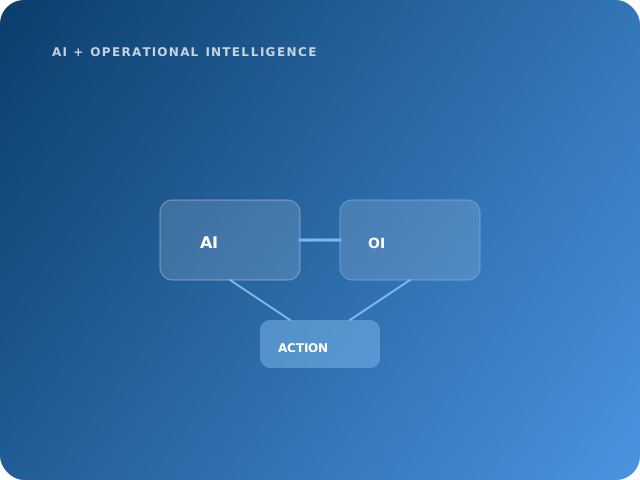
Operational Intelligence works on the same principle across industries: converting live data into instant decisions.
Thousands of data points are collected from hundreds of machines every second. OI analyses machine behaviour, compares with past failure records, and alerts maintenance teams before downtime — predictive maintenance.
Seeing vehicle location is standard. OI combines GPS, weather, traffic, delivery plans, and customer expectations — calculates delay probabilities and suggests alternative scenarios.
Daily revenue reports arrive after the store closes — the intervention window may be gone. OI monitors customer density, checkout queues, and stock movements live; when problems arise, it generates alerts — not reports.
Successful Operational Intelligence systems are built on three core elements. Real OI begins when it not only shows problems — but suggests solutions.
Data collection is no longer a competitive advantage — today everyone collects data. The real advantage lies in delivering the right data to the right person at the right time.
Operational Intelligence does exactly that. It enables managing today — instead of just reporting the past.
In the digital age, winners will not be those with the most data — but those who make the fastest, most accurate decisions with data.
Yes — live data accelerates decisions.
No — we only build stored and reported data piles.
Share your operational data and decision processes — let us design your live insight platform together.