
Yektasoft
Blog 20.08.2025 Yektasoft Engineering 12 min read

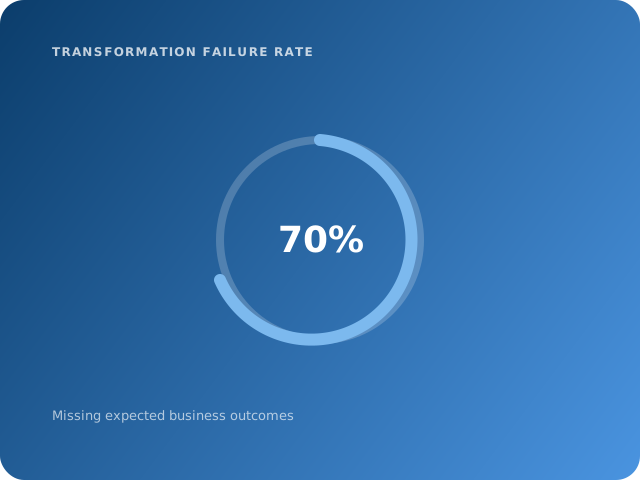
Why Do 70% of Digital Transformation Projects Fail?

The problem is usually not technology. It is treating digital transformation as a software project and ignoring change management.

Why Do 70% of Digital Transformation Projects Fail?

Companies today invest in digital transformation at unprecedented levels.

New ERP systems are deployed. CRM projects launch. Cloud migrations proceed. AI investments are planned.

Yet one reality remains unchanged:

A significant share of digital transformation projects fail to deliver expected business outcomes.

Some exceed budget. Some miss deadlines. Some go live technically but fail to deliver expected efficiency. Some are abandoned because employees never adopt them.

So why?

Is the problem really technology? Most of the time, no.

The real problem is treating digital transformation as a technology investment — not as a change management programme.
Technology does not transform by itself. Digitising a bad process only produces a faster bad process.

Digital Transformation Is Not a Software Project

Many organisations focus directly on technology when digital transformation is mentioned. These questions matter. Yet the real question is often missed:

Technology does not transform by itself. It only accelerates how you already work. If your processes are inefficient, technology accelerates inefficiency. If your processes are complex, technology carries that complexity into the digital world.

Therefore the starting point of digital transformation should be process — not technology.

"Which ERP will we use?"
"Which CRM will we choose?"
"Which business problem will this technology solve?"
Digital Transformation Is Not a Software Project

Four Core Reasons for Failure

Behind failed digital transformation projects, the same patterns usually appear.

Choosing Technology Without Understanding Processes

A common mistake is choosing software first, then trying to fit processes to it. The right approach is the opposite: analyse processes first, identify bottlenecks, simplify repetitive work — then choose technology. Successful projects start with a process map — not technology.

Ignoring the Human Factor

In digital transformation, technology changes — but the people living the change do not. Employees ask: "Will this make my job easier?" If the answer is unclear, resistance begins — and resistance often becomes a bigger barrier than technical issues. Successful organisations make employees stakeholders in the change.

Ignoring Data Problems

Many projects deploy new systems but never fix old data problems. Departments keep working in separate systems; reports become inconsistent. No system succeeds with bad data. Investing in technology without solving data problems is like building without a solid foundation.

Wrong Success Criteria

Many projects measure success by "Did the system go live?" Yet real success starts here: Did operational costs fall? Did error rates drop? Did decision-making speed up? Did customer satisfaction rise? The goal of digital transformation is not deploying software — it is improving business outcomes.

Three Critical Questions for Leadership

If a digital transformation project is underway in your organisation, you must ask these three questions:

  • Which business problem are we solving? — Ensure the problem is defined before choosing technology.
  • How will we measure success? — Business outcomes, not go-live dates, should define success.
  • Where are employees in this transformation? — Business units, not IT alone, must own the project.

What Do Successful Organisations Do?

Looking at successful digital transformation projects, we see a shared approach. These organisations are business-value-centric — not technology-centric.

Transformation becomes a corporate development programme — not a software project.

  • They analyse their processes first
  • Then they organise their data structures
  • They involve employees in the process
  • They link success criteria to business goals
  • They position technology as part of the strategy
What Do Successful Organisations Do?

Conclusion

Digital transformation projects fail not because of a lack of technology. The real reasons are: processes not analysed, human factors ignored, data problems unsolved, and transformation treated as a software project alone.

Technology can be bought. Software can be deployed. Systems can be replaced. But real transformation begins when you unite people, processes, data, and technology toward the same goal.

What determines success is not the brand of technology used — but the organisation's ability to manage change.

What determines success in digital transformation is not the technology brand — but the organisation's ability to manage change.

What do you think is the biggest reason digital transformation projects fail?

Technology choices?

Or failure to manage process, data, and people dimensions?

Let's plan your digital transformation journey together

Share your current processes and transformation goals — let us build a business-value-focused roadmap together.

Let's Talk